
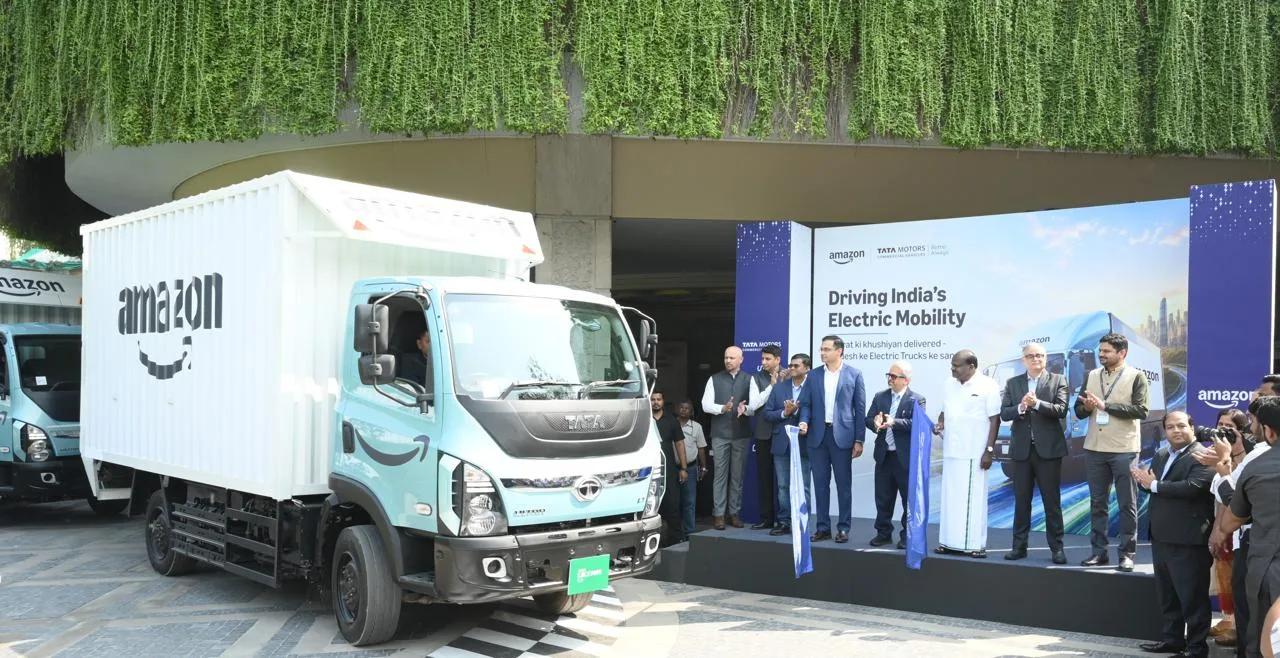
Amazon and Tata Motors have announced plans to deploy 3,000 electric trucks across Amazon’s transportation network in India, expanding the e-commerce company’s electrification efforts beyond last-mile deliveries.
Announced on October 27, 2026, the deployment will begin in Delhi during the festive season, when freight volumes typically rise. The electric trucks will transport shipments between facilities and across cities as part of Amazon’s middle-mile logistics network.
Under the arrangement, Tata Motors will supply the vehicles, while Amazon’s carrier partners will own and operate them. The companies describe the planned rollout as the largest electric-truck deployment by an e-commerce company in India.
Delhi–Bengaluru–Chennai Corridor Planned
The next phase aims to expand electric freight operations along a proposed 2,800-km Delhi–Bengaluru–Chennai corridor via NH48, spanning seven states. Dedicated charging infrastructure, including hubs being developed with charging provider Yahhvi, is expected to support the expansion.
Amazon said it already has more than 15,000 electric vehicles operating across over 500 Indian cities. The truck deployment extends its efforts into heavier commercial transportation, where range, payload, charging access and operating costs remain important considerations.
What Do the Trucks Offer?
The initial deployment includes Tata Ultra E.7 electric trucks, featuring an integrated e-axle, CCS2 fast charging, regenerative braking and a crash-tested cabin with high-voltage safety systems.
Tata Motors says the trucks are designed to reduce operating costs and improve uptime. However, the announcement did not disclose battery capacity, loaded driving range, payload specifications, vehicle pricing or the timeline for deploying all 3,000 trucks.
The companies also have not detailed the expected emissions reductions or the number of trucks planned for the highway corridor.
The partnership marks a significant step towards scaling electric freight in India. Its long-term impact will depend on whether the vehicles can deliver reliable operations and competitive costs across demanding logistics routes.