India’s electric vehicle story is no longer only about how many EVs are being sold.
The bigger question now is: who will make the batteries, cells, electronics and energy-storage systems needed to support the next phase of growth?
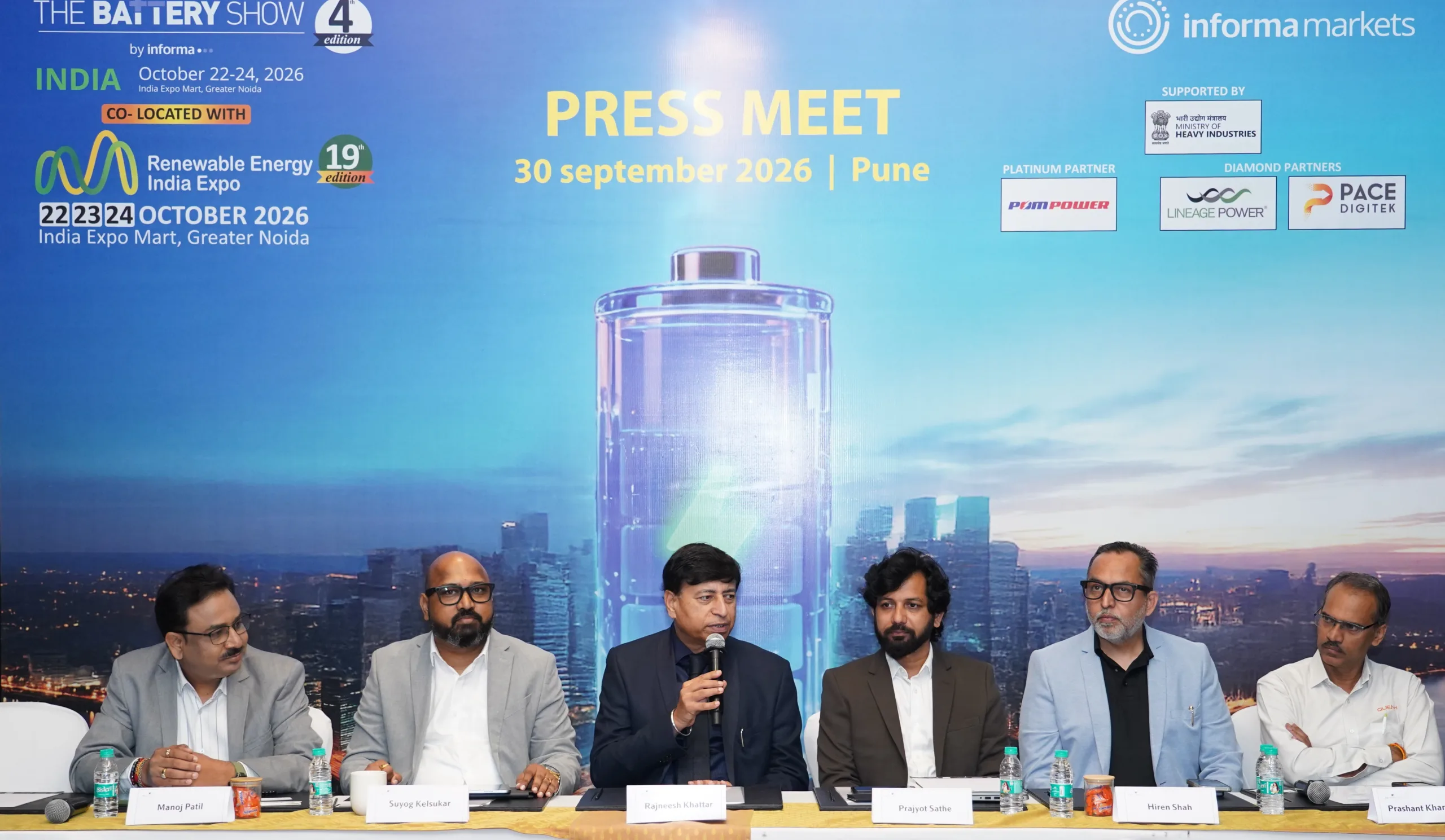
That was the focus of an industry roundtable held in Pune ahead of The Battery Show India 2026, where battery manufacturers, EV experts, automation companies and market researchers discussed how quickly India’s battery and energy-storage ecosystem is changing.
The industry expects India’s battery-electric passenger car market to reach around 1.8–1.9 lakh units in 2026, up from about 1.78 lakh units in 2025 and 99,000 units in 2024. Industry experts also see the passenger EV market reaching around 15 lakh annual units by 2032.
But passenger cars are only one part of the story.
The next battleground could be much bigger — battery cells, localisation, BESS, automation and the domestic supply chain.
India’s EV Market Is Moving Beyond Two-Wheelers
India’s EV journey started largely with electric two-wheelers and three-wheelers.
That is changing.
According to Frost & Sullivan, the market is gradually moving from electric two-wheelers to three-wheelers, light commercial vehicles and buses, while passenger cars are developing at a later stage.
This shift is important because every new EV segment increases demand for batteries, power electronics, charging infrastructure and manufacturing capacity.
And the industry believes the next phase will be less about subsidies and more about economics.
Suyog Keluskar, Senior Director at 1Lattice, said the market is increasingly moving towards total cost of ownership (TCO). According to the roundtable discussion, one in eight vehicles retailed in August 2026 was electric, while electric commercial vehicles more than doubled their share to 5.18% in a year.
That is an important change.
Fleet operators, for example, cannot buy EVs simply because they are promoted as green vehicles. They need the numbers to work.
Running cost, battery life, charging and uptime now matter just as much as the purchase price.
Battery Demand Could Grow Nearly 10 Times
The numbers around battery demand are even more striking.
Industry estimates discussed at the Pune roundtable suggest that demand for advanced battery cells could rise from around 28 GWh in 2025 to nearly 272 GWh by FY2030.
At the same time, the domestic cell manufacturing capacity is still close to 1 GWh.
That leaves India with a massive gap to fill.
This is where the next opportunity lies.
India is not just trying to sell more electric vehicles. It is trying to build a domestic battery ecosystem around them.
That means cells.
It means battery packs.
It means BMS.
It means testing.
It means automation.
And increasingly, it means recycling and energy storage as well.
LFP Is Leading, But New Battery Chemistries Are Coming
LFP chemistry has emerged as the dominant battery chemistry in the current market.
However, the industry is already looking beyond it.
Experts at the roundtable pointed to sodium-ion, lithium-sulphur and solid-state batteries as technologies that could become more important over the next four to six years.
The challenge is not simply developing these technologies.
India also needs to manufacture them competitively.
Prajyot Sathe of Frost & Sullivan said component localisation is currently around 50–60% and could potentially rise to 80–90% over the next five to six years.
But there is a catch.
Battery cells and power electronics are expected to remain below 60% localisation for longer, showing just how difficult it will be to build a truly domestic EV supply chain.
Battery Storage Is Becoming a Bigger Story Than EVs
Perhaps the most interesting point from the roundtable is that batteries are no longer being viewed purely as an EV component.
They are becoming part of India’s electricity infrastructure.
India will need around 236 GWh of battery storage by FY2032, according to the estimates discussed during the event.
Why?
Because renewable energy does not always produce electricity when consumers need it.
Solar generates during the day.
Demand continues after sunset.
That is where battery energy storage systems, or BESS, come in.
They can store excess generation and release it when required, helping with grid stability and power management.
This could turn batteries into a much larger market than EVs alone.
Replus Is Scaling Its BESS Business
Replus Engitech is already working in this space.
According to its management, the company is deploying around 1.2 GWh across applications including FDRE, round-the-clock power, solar-plus-storage, standalone BESS and transmission and distribution projects.
Its current plant capacity is around 1 GWh, with plans to scale it to 6 GWh, with the additional facility expected to become operational from January 2027.
The company also sees major demand across grid-scale, commercial and industrial and EV battery applications.
Its management estimates battery demand over the next decade at around 480 GWh for grid-scale applications, 380–400 GWh for C&I and 420 GWh for EV batteries.
That gives an idea of how quickly India’s battery opportunity is expanding beyond vehicle manufacturers.
Automation Could Become the Hidden Backbone of Battery Manufacturing
More batteries also mean more factories.
And more factories mean more automation.
Patil Automation said it is already supplying automated manufacturing lines for cells, modules and battery packs as demand grows across two-wheelers, three-wheelers, cars, buses, trucks and BESS.
The company expects the share of smaller battery components manufactured in India to rise from around 30–35% to 70–80% over the coming years.
That is significant because battery manufacturing is not simply about putting cells inside a pack.
Modern production needs traceability, testing, quality control and automation at every stage.
A small manufacturing error can have serious consequences when thousands of battery packs leave a factory.
Testing and Safety Will Matter More as Production Scales
As India’s battery industry grows, safety and traceability will become increasingly important.
Patil Automation said its systems track data at each manufacturing stage, allowing manufacturers to monitor production processes and improve traceability.
This is one area where India’s battery industry cannot afford to cut corners.
More EVs on the road mean more batteries in circulation.
More BESS installations mean larger energy systems.
As volumes rise, manufacturers will have to prove not just that they can make batteries, but that they can make them consistently and safely at scale.
India Is Also Building the Electronics Around Batteries
Battery manufacturing does not end with cells and packs.
Power conversion systems, energy-management software, chargers and testing equipment are all becoming part of the ecosystem.
Ador Digatron said it has moved from its earlier lead-acid battery business towards lithium-ion technologies and now manufactures chargers as well as formation and testing systems for lithium-ion batteries.
The company has also entered the power-conversion system market for energy storage, with PCS solutions ranging from 500 kW to 2.5 MW, while exploring energy-management systems.
For India, this matters for one simple reason.
If the country wants to reduce dependence on imported technology, manufacturing cells locally is only one part of the job.
The wider ecosystem has to develop around them.
Why Pune Is Important to India’s EV Industry
The decision to hold the industry roundtable in Pune was not accidental.
Pune remains one of India’s major automotive and engineering hubs.
According to the Maharashtra Industrial Development Corporation, the Pimpri-Chinchwad region alone has more than 4,000 automotive and ancillary units, along with R&D, testing and certification facilities.
Maharashtra’s EV Policy 2025 also envisages Pune playing a role in EV, charging infrastructure, hydrogen technology and battery-recycling capabilities.
That makes Pune an important part of the larger transition from conventional automotive manufacturing to EV and energy technology.
The Battery Show India 2026 Will Bring the Ecosystem Together
The discussions in Pune come ahead of the fourth edition of The Battery Show India 2026, scheduled from October 22 to 24 at India Expo Mart & Centre, Greater Noida. The event will run alongside the Renewable Energy India Expo and Energy Storage Summit India.
The official event information says the 2026 edition will bring together battery, EV and energy-storage companies, with more than 450 brands and 20,000 industry visitors expected.
For an industry that is still building its domestic supply chain, such events are becoming more than exhibitions.
They are places where manufacturers meet technology providers, suppliers meet OEMs, and new battery and energy-storage businesses look for customers and investment.
What This Means for India’s EV Industry
The message coming out of Pune is fairly clear.
India’s EV story is entering a different phase.
The first phase was about getting consumers to buy EVs.
The next phase is about building everything around them.
That means producing more cells in India, developing domestic battery materials and components, expanding BESS, improving automation and testing, and creating a supply chain that can compete on cost as well as technology.
The numbers suggest the opportunity is enormous.
But the challenge is equally large.
India may have a rapidly growing EV market, yet a large part of the underlying battery ecosystem still needs to be built.
And that could be the real opportunity of the next decade.
The EV revolution started with the vehicle. The next one may be won inside the battery factory.