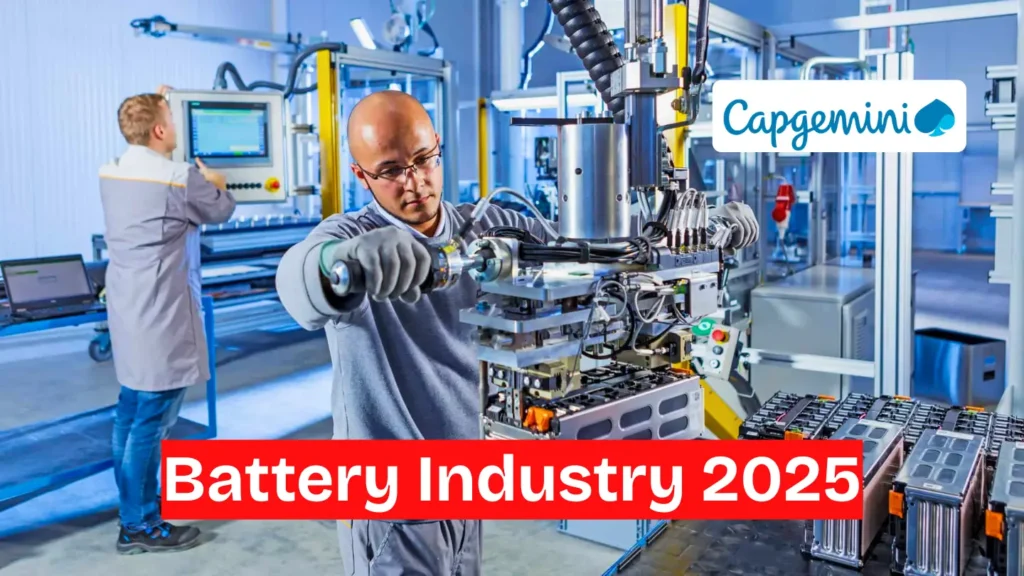
While lithium-ion batteries remain dominant, next-generation technologies like solid-state batteries are poised to redefine energy storage and mobility. 76% of manufacturers will need new or upgraded production lines to meet future demands.
India, February 28, 2025 – A new report by the Capgemini Research Institute, ‘The Battery Revolution: Shaping Tomorrow’s Mobility and Energy’, highlights the pivotal role of batteries in decarbonizing industries and enabling innovative business models.
However, the sector faces a critical juncture: accelerating production to meet surging demand for electric vehicles (EVs) and renewable energy storage, while advancing next-generation chemistries to achieve higher energy density, safety, and sustainability.
The report underscores that the industry’s growth hinges on addressing challenges across the value chain—from securing ethical raw materials and optimizing manufacturing to scaling recycling infrastructure.
With EVs and energy storage driving unprecedented demand, battery manufacturers must also reduce costs and innovate rapidly to stay competitive.
Lithium-Ion Dominance Meets Emerging Alternatives
Lithium-ion batteries, used by 98% of surveyed manufacturers, continue to lead due to their reliability and mature supply chains. Yet the industry is actively pursuing alternatives.
Solid-state batteries, with their potential for faster charging, enhanced safety, and higher energy density, are emerging as a game-changer for EVs.
These innovations align with global decarbonization goals but require significant R&D and production overhauls.
Pierre Bagnon, Global Head of Intelligent Industry Accelerator at Capgemini, emphasized: “Innovation and digitalization are the backbone of a sustainable battery ecosystem. While manufacturers in Europe and North America grapple with scaling production, a robust digital foundation will be key to optimizing quality, recycling, and lifecycle management. Collaboration across industries and regulators is equally vital to unlock a battery-powered future.”
New Business Models Reshape Mobility and Energy
The report reveals evolving business strategies aimed at democratizing access to clean energy:
- 64% of mobility companies are exploring battery-swapping solutions.
- Over 60% of automakers are considering battery-leasing or Battery-as-a-Service (BaaS) models, decoupling battery costs from EV ownership.
- 69% of energy firms are integrating batteries with renewables to optimize storage, though challenges like outdated grid infrastructure and cost disparities persist.
Beyond automotive and energy, sectors like aviation and shipping are poised for disruption. Innovations include battery-powered eVTOLs (air taxis), electric heavy-duty trucks, and short-range electric vessels.
Production Challenges: Gigafactories, Talent, and Sustainability Gaps
Scaling gigafactories remains a hurdle, with 59% of manufacturers citing delays in factory ramp-ups and 53% struggling with supply chain instability. Economic uncertainties further complicate expansion plans. A critical talent shortage compounds these issues—60% of organizations lack expertise in battery tech, manufacturing, and data science needed to optimize production.
Sustainability efforts lag, with only a third of manufacturers making strides toward a circular economy. While 67% recognize digital tools as essential to progress, adoption remains low (17%). Europe’s upcoming digital battery passport, tracking environmental standards across a battery’s lifecycle, could incentivize greener practices.
Methodology
Capgemini surveyed 750 executives from battery, automotive, and energy sectors across 15 countries in North America, Europe, and APAC. Participants included large-scale manufacturers (revenue >50Mforbatteries;>1B for automotive/energy). Interviews with 22 industry experts supplemented the data, collected between September and October 2024.
The Path Forward
As batteries become the linchpin of global decarbonization, overcoming production bottlenecks, fostering talent, and prioritizing sustainability will define the industry’s success. With collaboration and digital innovation, next-generation batteries could revolutionize mobility, energy, and beyond.
Full Report here – A dual challenge for the battery industry: ramping up production while innovating game-changing chemistries for the future