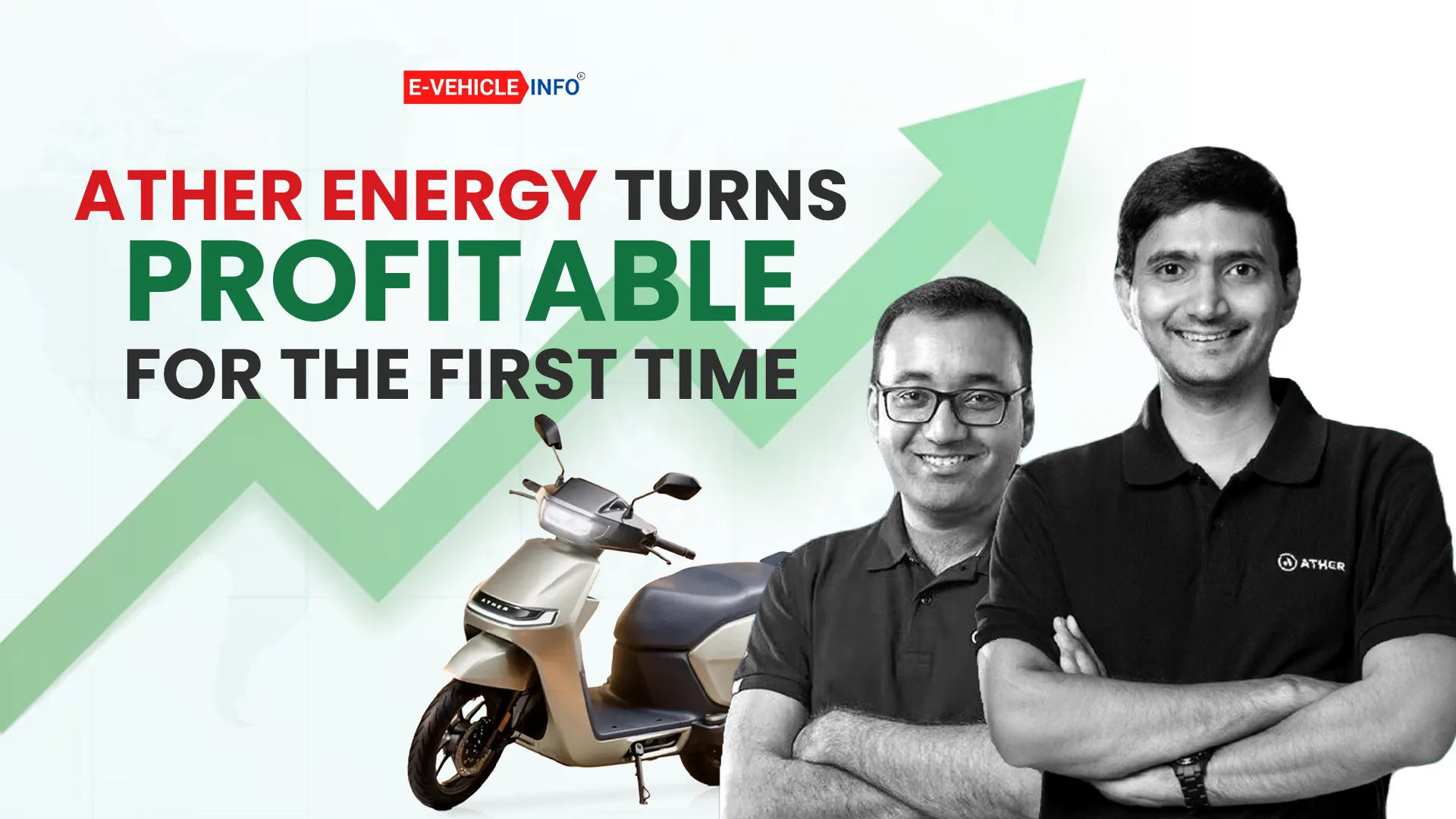
From a ₹154 crore quarterly loss to a ₹1.26 crore profit. Ather Energy has reached a major milestone. But with razor-thin margins, declining market share and negative operating cash flow, the real test of its turnaround is only beginning.
For years, one question has followed India’s electric two-wheeler industry: can an EV manufacturer sell scooters at scale and actually make money?
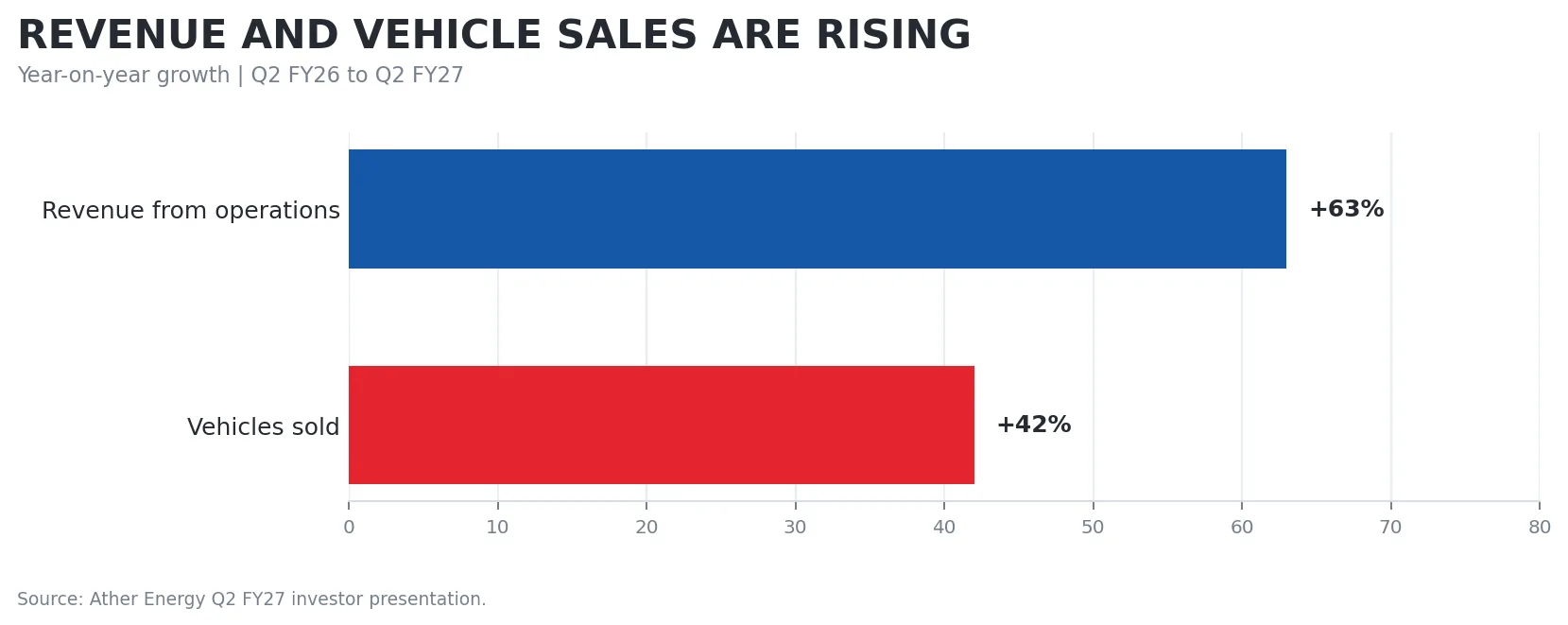
Ather Energy’s Q2 FY27 results offer an encouraging answer. The Bengaluru-based company reported its first quarterly profit after tax, with revenue from operations climbing to ₹1,464.24 crore and vehicle sales increasing 42% year-on-year.
But there is a catch. Ather retained just ₹1.26 crore in profit against total income of ₹1,526.95 crore.
There is another detail behind Ather’s headline profit. Revenue from operations stood at ₹1,464.24 crore, while total expenses reached ₹1,525.69 crore. The company’s ₹62.7 crore in other income helped offset the gap, leaving a net profit of ₹1.26 crore. In other words, the quarter was profitable overall, but operating revenue alone did not cover total expenses.
1. From a ₹154 Crore Loss to a Profit
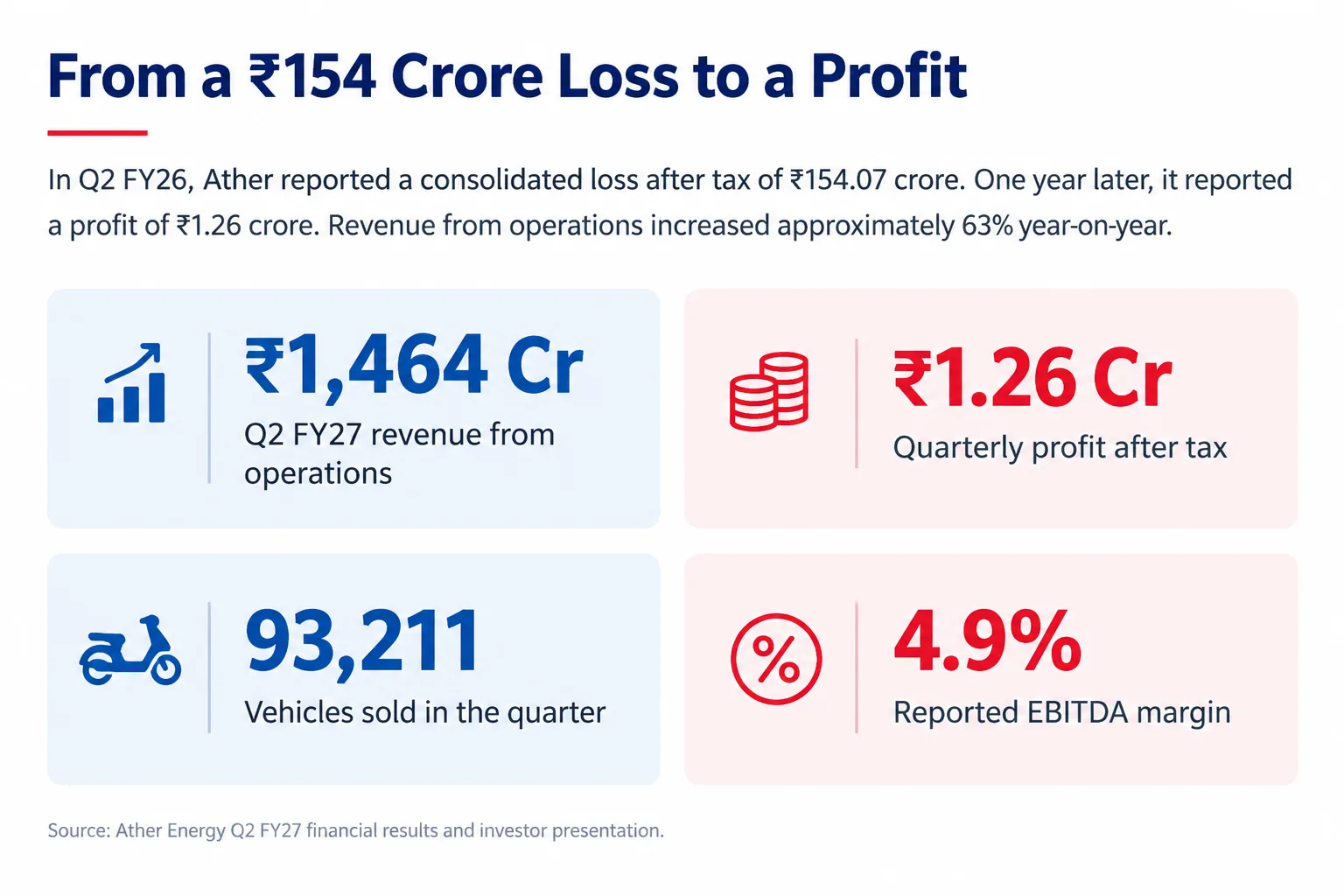
In Q2 FY26, Ather reported a consolidated loss after tax of ₹154.07 crore. One year later, it reported a profit of ₹1.26 crore. Revenue from operations increased approximately 63% year-on-year.
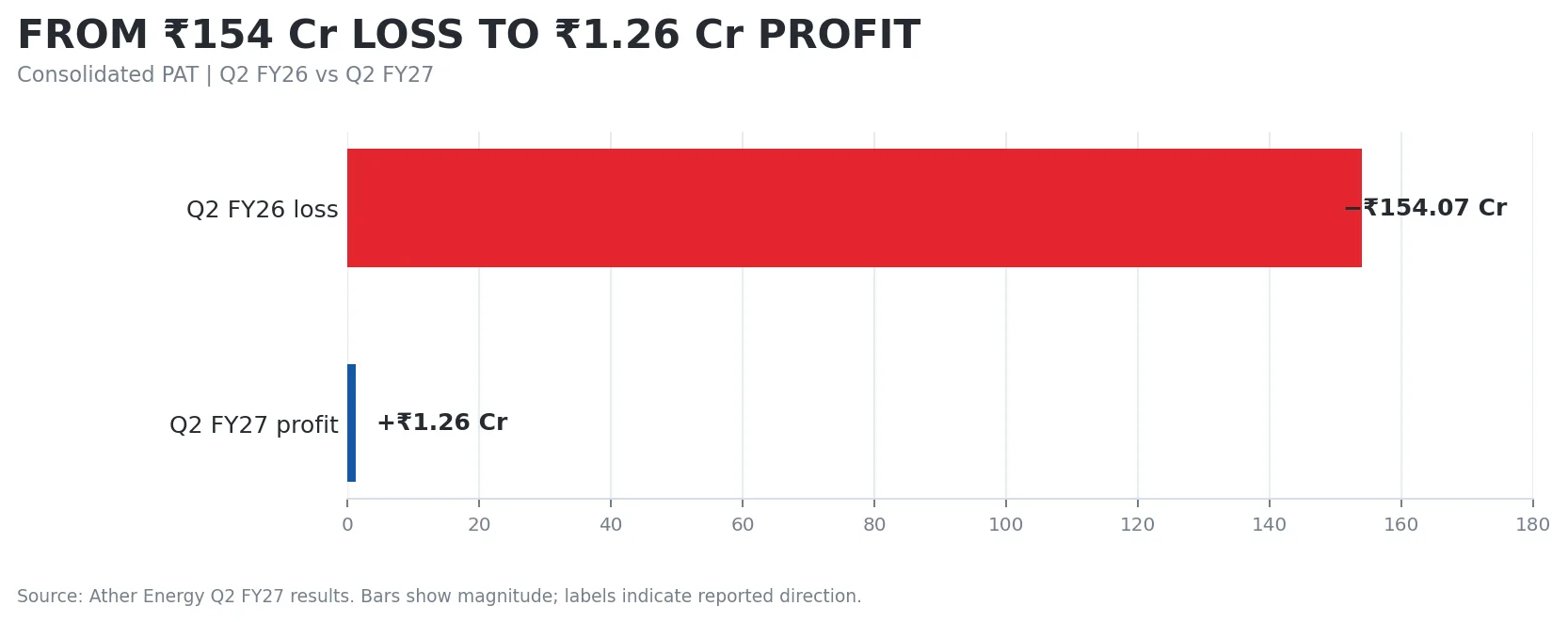
The improvement is substantial, but the final profit remains extremely small relative to revenue. A net margin of approximately 0.08% leaves little room for unexpected costs, price competition or slower demand.
The more encouraging signal is EBITDA. Ather reported ₹74.17 crore in EBITDA, compared with negative ₹90.76 crore a year earlier. Its EBITDA margin improved from −9.6% to 4.9%.
That suggests the company’s underlying operating performance has improved considerably. But EBITDA is not the same as net profit or cash flow. Depreciation, financing costs, taxes and working-capital requirements still matter.
2. More Scooters, More Revenue
Ather sold 93,211 vehicles in Q2 FY27, compared with 65,595 in the year-ago quarter. Its adjusted gross margin also improved from 22% to 24%.
Higher volumes can help a manufacturer spread fixed costs across more vehicles. Factory operations, engineering, software development and administration do not necessarily rise in direct proportion to every additional scooter sold.
Ather attributes its improved gross margin to factors including pricing decisions and product mix, despite cost pressures involving materials such as aluminium, copper, lithium and crude-linked plastics.
The challenge now is to preserve those margins while remaining competitive. Buyers compare price, range, charging access, features and service quality. If competition forces heavy discounting, some of the progress could come under pressure.
3. Demand Is Surging. But Can Ather Deliver?
Ather reported approximately 10 lakh customer enquiries during the quarter, up 109% year-on-year. Pre-orders more than doubled to around 1.80 lakh. The company also said its Hosur facility reached 98% capacity utilisation at peak production.
Customer Interest Is Accelerating
Reported year-on-year growth in Q2 FY27
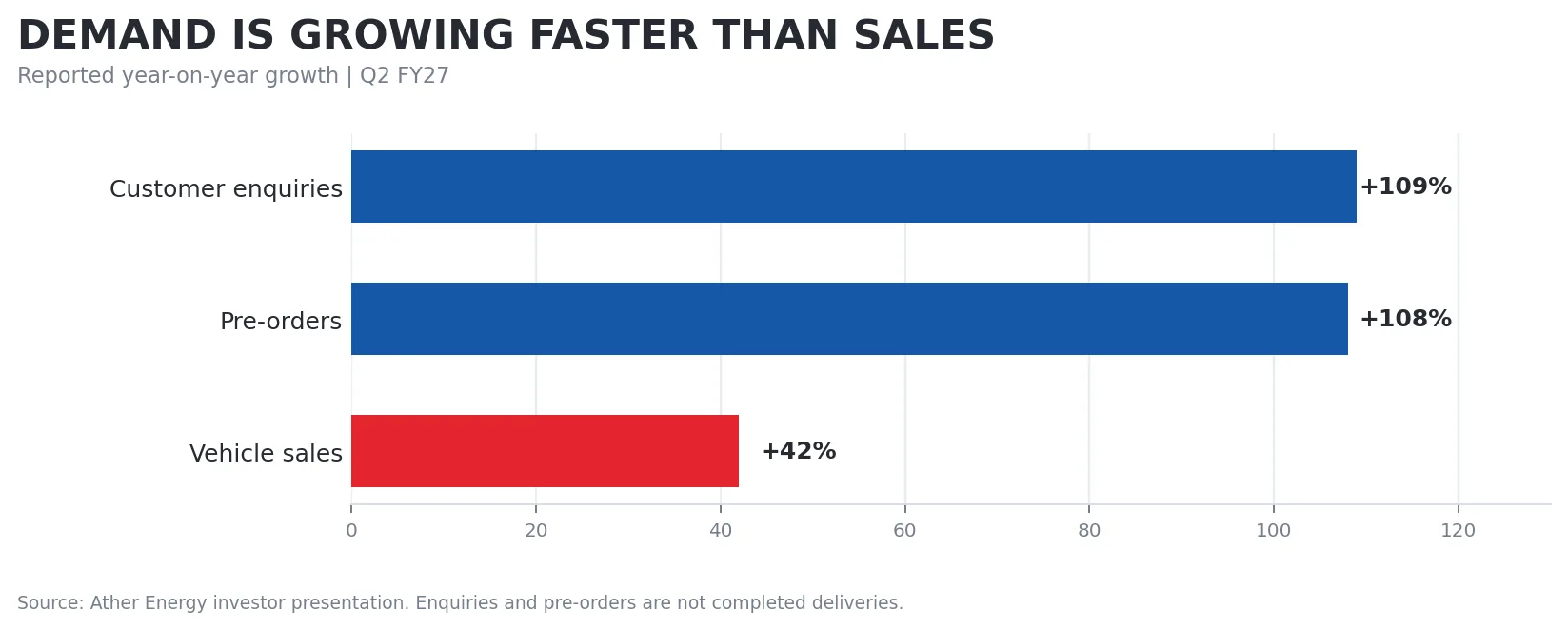
These numbers help explain why Ather is expanding manufacturing capacity. However, enquiries can fail to convert, pre-orders can be cancelled and production constraints can delay deliveries.
The real test is whether Ather can convert this interest into completed sales without compromising quality, delivery timelines or after-sales support.
4. The Market-Share Twist
India’s electric two-wheeler market is growing quickly. Ather’s investor presentation puts industry registrations at approximately 5.98 lakh units in Q2 FY27, up 82% year-on-year.
Yet Ather’s reported market share fell from 17.2% to 15.1% year-on-year.
Growing Sales, Lower Market Share
Ather’s reported electric two-wheeler market share
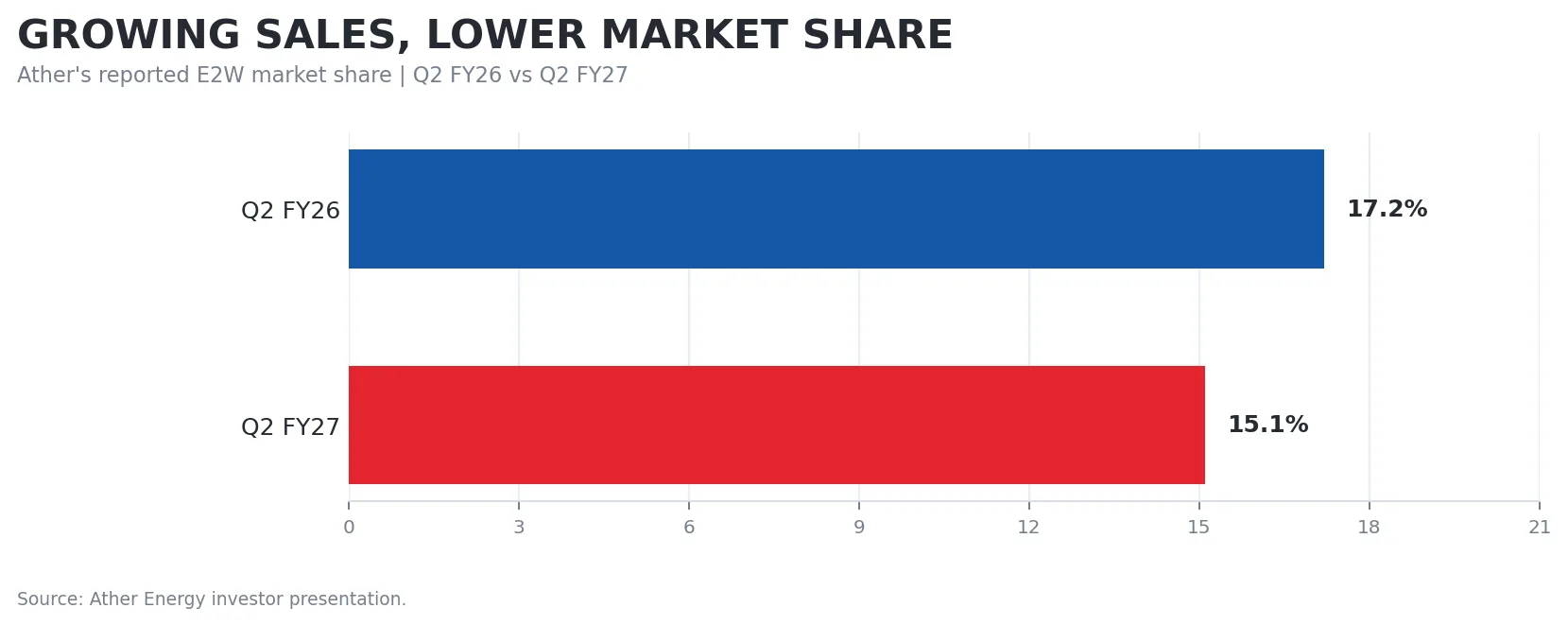
This is the competitive challenge hidden behind the profit headline. Ather is selling more scooters, but the broader market has grown faster.
TVS Motor, Bajaj Auto, Hero MotoCorp’s Vida and other manufacturers are competing for customers with expanding electric portfolios, manufacturing scale and established distribution networks.
Ather does not necessarily need to be the biggest manufacturer to build a profitable business. But it needs to defend its position while the market expands around it.
5. Ather Is Betting on More Manufacturing Capacity
Ather has approved approximately ₹122 crore in additional investment across its Hosur facility in Tamil Nadu and its under-construction AURIC facility in Maharashtra.
Planned Annual Manufacturing Capacity
Company targets; units per year
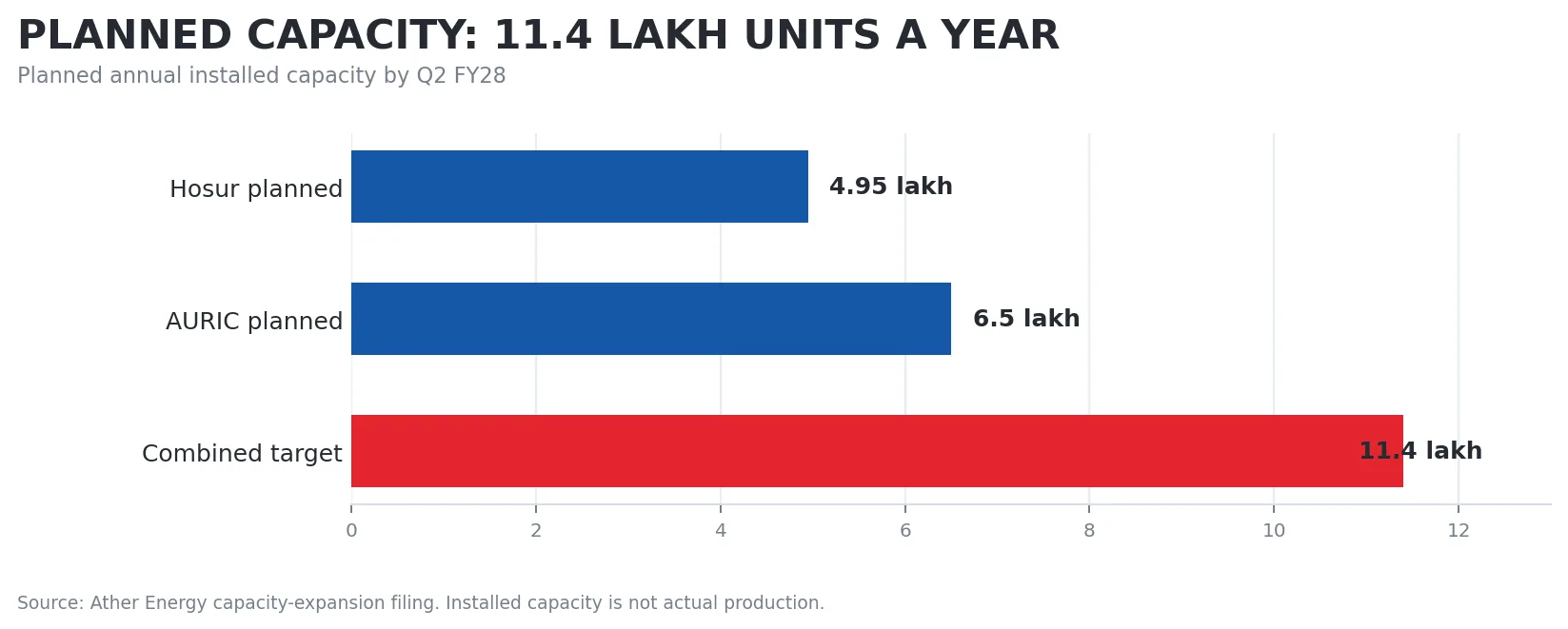 The plan is to increase annual capacity at Hosur from 4.2 lakh to 4.95 lakh units by December 2026, and expand planned AURIC capacity from 5 lakh to 6.5 lakh units by Q2 FY28.
Ather has also earmarked ₹53 crore for a new battery line at Hosur, expected to be completed by Q3 FY28, to support demand and reduce supply-chain risk.
More capacity could help Ather serve more customers. But factories must be commissioned on time, production must ramp up efficiently, and suppliers, logistics and service operations must keep pace.
Installed capacity is not the same as output—and output is not the same as retail sales.
6. The Business Beyond Scooters
Non-vehicle revenue accounted for 15% of Ather’s revenue from operations in Q2 FY27, compared with 12% a year earlier. This includes software, charging, accessories, spare parts and service. The company reported a 94% attach rate for AtherStack Pro.
The strategy is straightforward: revenue need not end when a scooter leaves the showroom. Software, charging and service can create additional customer touchpoints throughout the vehicle’s life.
Ather is also broadening its portfolio with the performance-focused 450 series, family-oriented Rizta and Konarc on the new EL platform.
However, a growing contribution from non-vehicle revenue does not automatically mean those businesses are highly profitable. The economics of each category will matter as much as its share of revenue.
7. The Cash-Flow Reality Check
For the six months ended September 2026, Ather still reported a consolidated net loss of ₹49.83 crore. Net cash used in operating activities was ₹40.05 crore, compared with net cash generated of ₹77 crore in the corresponding period a year earlier.
The company also reported approximately ₹520 crore of capital expenditure on property, plant, equipment, intangible assets and related work-in-progress during the first half.
Ather has raised equity capital to support its plans. That funding can help finance expansion, but money raised from investors is not the same as cash generated by selling scooters.
For a sustainable turnaround, Ather needs to demonstrate consistent earnings and a stronger ability to fund its operations through cash generated by the business.
So, Has Ather Turned the Corner?
Ather has made real progress. Revenue is up, vehicle volumes are higher, EBITDA has turned positive and gross margins have improved.
But three questions remain:
- Can Ather report profits consistently over several quarters?
- Can it turn those profits into positive operating cash flow?
- Can it grow fast enough to defend market share as competition intensifies?
The Bottom Line
Ather Energy has shown that quarterly profitability is possible. But a ₹1.26 crore profit on more than ₹1,500 crore in total income leaves very little room for error.
The milestone was making a profit. The real victory will be making that profit consistently—while delivering more scooters, defending market share and turning growth into cash.
Sources: Ather Energy Q2 FY27 financial results, investor presentation and capacity-expansion filing dated October 26, 2026. The results are unaudited and subject to a limited review. Capacity figures are company targets. This article is editorial analysis, not investment advice.