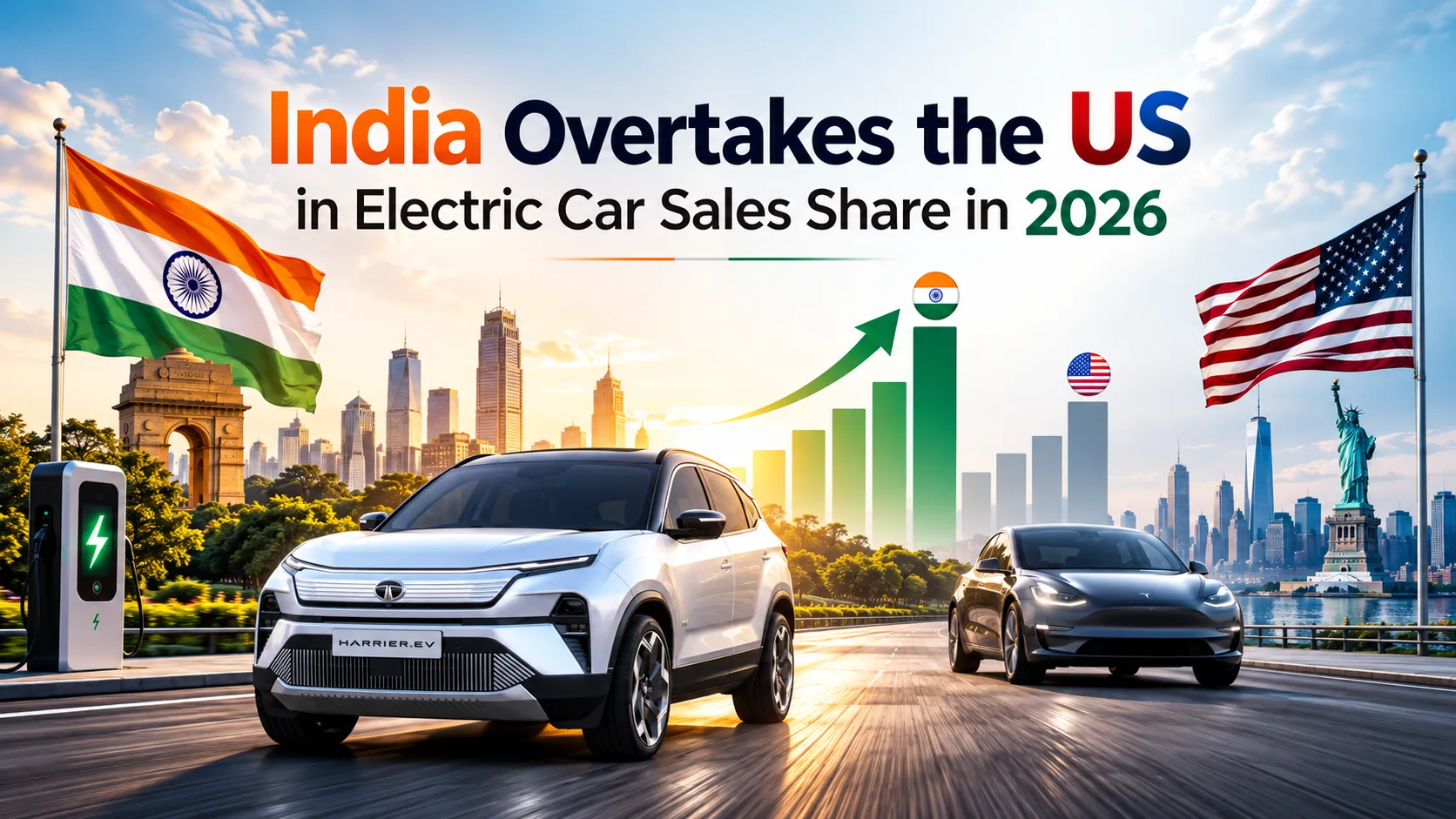
India has reached a milestone that would have seemed unlikely just a few years ago. In the share of new car sales accounted for by fully electric vehicles, India has moved ahead of the United States—one of the world’s largest automotive markets.
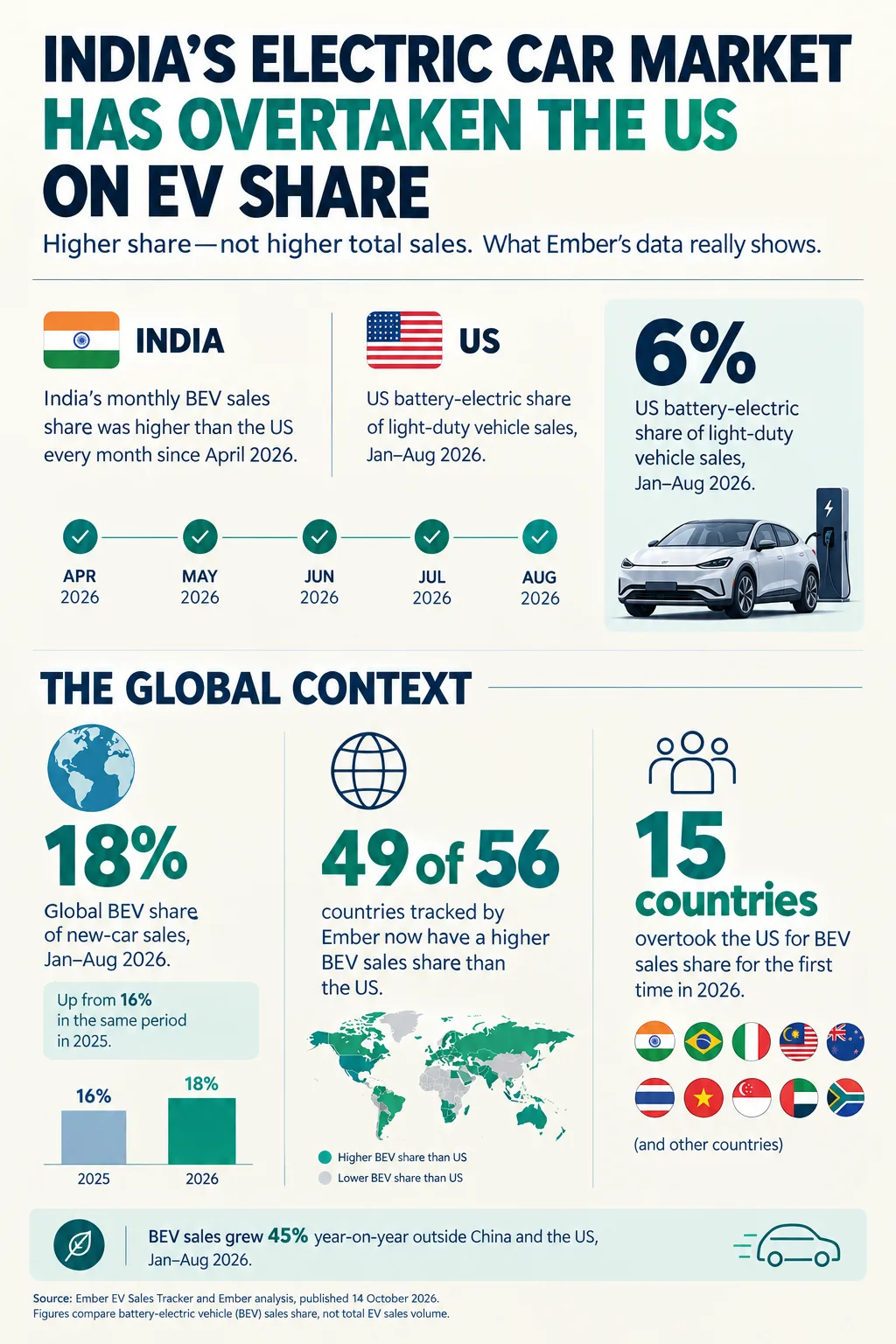
According to energy think tank Ember, India recorded a higher battery-electric vehicle (BEV) sales share than the US in every month from April 2026 onwards. The finding, published on 14 October 2026, places India among a growing group of countries where electric cars are becoming a more significant part of the new-vehicle market.
But the headline needs context. India has not overtaken the US in total electric-car sales, installed charging infrastructure, or the number of EVs already on the road. What has changed is the proportion of new cars being sold that run entirely on electricity.
That distinction matters. It tells us something important about the direction of India’s automotive market—and about the changing geography of the global electric-vehicle transition.
What the Data Actually Says
As per Ember’s monthly EV Sales compares new vehicle registrations by drivetrain across 56 countries, alongside regional and global figures. It tracks battery-electric cars separately from plug-in hybrids, conventional hybrids and combustion-engine vehicles.
Its latest analysis found that battery-electric vehicles accounted for approximately 6% of US light-duty vehicle sales during the first eight months of 2026. India, meanwhile, recorded a higher BEV sales share than the US in each month beginning in April.
The shift extends beyond these two countries. Of the 56 countries covered by Ember, 49 had a higher BEV sales share than the US in the period examined. Fifteen countries, including India, Brazil, Italy, Malaysia and New Zealand, moved ahead of the US for the first time in 2026.
The global market is also expanding. BEVs represented 18% of new car sales worldwide during January–August 2026, compared with 16% during the same period in 2025.
These figures point to a broadening electric-car market. Adoption is no longer defined solely by the traditional leaders or by the world’s largest economies.
Why India’s Progress Matters
For much of the past decade, discussions about electric cars in India centred on a familiar set of obstacles: high upfront prices, concerns about driving range, limited public charging, and uncertainty about battery life and resale value.
Those barriers have not disappeared. Yet electric cars are increasingly becoming a credible option for Indian buyers, supported by a growing choice of domestic models, new product launches and investments across the automotive supply chain.
India also has a different market structure from the United States. A large share of its passenger-car demand is concentrated in price-sensitive segments, making vehicle affordability particularly important. Manufacturers that can offer a practical electric car at a competitive price have the potential to reach buyers who previously considered EVs too expensive or inconvenient.
Domestic automakers are central to this shift. Ember’s analysis found that Tata Motors and Mahindra Electric together accounted for more than 60% of India’s EV sales in the first half of 2026. Their position reflects the importance of locally developed products, established distribution networks and the ability to serve buyers across different price categories.
The wider market is also becoming more competitive. International manufacturers and newer entrants are expanding their presence, while established Indian companies continue to develop electric platforms and broaden their portfolios.
The next phase will depend on whether these manufacturers can turn early adoption into sustained demand—not simply by launching new vehicles, but by improving affordability, ownership experience and customer confidence.
The US Comparison Reveals a Different Kind of Slowdown
The United States remains one of the world’s most important automotive markets, with an established manufacturing base, extensive road networks and a sizeable electric-vehicle industry.
Its lower BEV sales share in 2026 does not mean the country’s EV industry has disappeared. It does, however, highlight how sensitive adoption can be to policy and market conditions.
Ember links the US slowdown partly to the rollback of federal support for electric vehicles in 2025. Incentives can influence the final purchase price, particularly for buyers comparing an electric vehicle with a similarly priced petrol-powered model. Changes in those incentives can therefore affect demand.
Vehicle prices, financing costs, the availability of affordable models, charging access and consumer confidence also influence adoption. No single policy change explains every movement in a national market, but policy consistency can make a substantial difference when buyers are deciding whether to switch technologies.
India and the US are consequently moving through the transition under different economic and policy conditions. Their sales shares offer a useful comparison, but they should not be treated as a simple ranking of which country has the stronger automotive industry.
Market Share Is Not the Same as Market Size
This is the most important distinction in the headline.
EV sales share measures the proportion of new vehicles sold that are electric. It does not measure the total number of EVs sold, the size of a country’s existing electric fleet, or its overall manufacturing capacity.
A country with a relatively small car market can achieve a high EV share while selling fewer electric cars in absolute numbers than a country with a much larger market. Conversely, a country can sell a substantial number of EVs but still record a lower share if its total new-car market is much larger.
The same distinction applies to infrastructure. A rising BEV sales share does not, by itself, establish that public chargers are sufficient, that charging is evenly distributed, or that electricity networks are ready for much larger fleets.
There is also a methodological point worth noting. Ember compiles information from national registration authorities, industry associations and other sources. Where national reporting differs, its dataset documents differences in scope and classification. Readers should therefore interpret international comparisons alongside the underlying definitions rather than assume every country measures registrations in exactly the same way.
India’s progress is significant without overstating what the figures establish.
Can India Sustain the Momentum?
The harder question is not whether India has moved ahead of the US on this particular measure. It is whether the country can maintain and broaden that progress.
Affordability will remain decisive
Electric cars must work for buyers outside the early-adopter segment. A wider range of competitively priced vehicles, accessible financing and predictable running costs will be important to reaching more households.
The purchase price alone does not determine affordability. Insurance, financing, maintenance, home-charging installation and the ability to charge conveniently all affect the ownership calculation.
Charging must keep pace with the fleet
Home charging can make EV ownership practical for households with suitable parking. Public charging becomes more important for drivers without private parking, apartment residents and people travelling longer distances.
Expansion needs to account for reliability and location, not just the number of chargers announced or installed. A charger that is unavailable, poorly maintained or inconveniently located does little to improve the ownership experience.
Domestic manufacturing needs to deliver competitiveness
India’s automotive industry has an opportunity to build expertise across vehicle engineering, power electronics, battery systems, software and charging technology.
But a higher sales share is not proof that the entire supply chain is domestically controlled. Battery-cell production, critical materials, imported components and manufacturing economics remain separate questions that require company-level and industry-level evidence.
For policymakers and manufacturers, the objective should be to make electric mobility commercially sustainable while developing a resilient supply chain.
Consumer confidence will determine repeat growth
Real-world range, battery durability, after-sales service and resale value will influence whether today’s buyers recommend EVs to others. Stronger sales can help build an ecosystem, but a durable market requires good ownership experiences after the initial purchase.
India’s EV Story Is Becoming Part of a Global Shift
The significance of India’s recent performance becomes clearer when viewed against the wider global market.
Ember reported that global BEV sales grew by 11% year-on-year during the first eight months of 2026, despite policy changes affecting demand in major markets. Outside China and the US, BEV sales grew by an estimated 45% over the same period.
The data suggests that the electric-car transition is spreading across a wider range of economies. Some markets are advancing through long-standing policies, while others are responding to new vehicle choices, changing fuel economics or efforts to strengthen energy security.
India’s position is especially relevant because the country’s transport system and oil demand have implications far beyond the automotive sector. A larger electric-car fleet can reduce exposure to imported petroleum over time, although the scale of that benefit depends on actual vehicle use, electricity demand and the energy sources supplying the grid.
This is not an argument that electric cars solve every energy or transport challenge. It is evidence that vehicle electrification can become an increasingly important part of a broader strategy to reduce oil dependence.
The Next Milestone Is More Important Than the Ranking
India moving ahead of the US in BEV sales share is a meaningful signal. It shows that electric cars are gaining ground in a market where affordability and practical ownership considerations carry considerable weight.
But a single comparison should not be mistaken for a final verdict on either country. Market shares fluctuate, national policies change, and the latest figures can be revised as registration data becomes available.
The more revealing test will be whether India can sustain rising electric-car adoption across multiple price segments, expand dependable charging access and build a competitive manufacturing ecosystem.
For now, the lesson is straightforward: the global EV race is no longer defined by a handful of established markets. India’s progress demonstrates that the balance of adoption is shifting—and that the next stage of the transition will depend as much on affordability, infrastructure and industrial capability as on technology itself.
For India’s EV industry, overtaking the US on sales share is a milestone. Turning that milestone into lasting market growth is the real challenge.